Carnival in Germany: From Cologne’s Party to the Black Forest’s Magic
🎭 The Tale of Two Carnivals: Rhineland vs. Black Forest
Germany’s carnival season is a vibrant tapestry woven from diverse regional customs. Understanding the fundamental differences is key to appreciating its magic.
1. The Rhineland Carnival (Karneval): Satire, Sweets, and Song
Centered around cities like Cologne, Düsseldorf, and Mainz, the Rhineland Carnival is famous for its lively, often irreverent spirit. It’s a time when rules are suspended, and political satire takes center stage.
- Colorful Chaos: Expect massive, organized parades featuring elaborate floats that often mock politicians and current events.
- “Kamelle” and “Bützchen”: Thousands of kilos of candy and flowers (“Kamelle”) are thrown to the eager crowds. Don’t be surprised if you get a friendly “Bützchen” (small kiss) on the cheek!
- Organized Merriment: Carnival societies, often dressed in uniforms that playfully mock 19th-century Prussian soldiers, organize the events, balls, and parades.
- The Dreigestirn: In Cologne, the Prince, the Peasant, and the Maiden (traditionally played by a man) form the “Triumvirate” that rules the season.
- The Call: The iconic shout is “Kölle Alaaf!” (Cologne Above All!)
2. Swabian-Alemannic Fastnacht (Fasnet): Ancient Spirits and Artisan Masks
Head south to the Black Forest and Lake Constance, and you’ll enter a world far removed from the Rhineland’s party. This is Fasnet, a deeply traditional celebration focused on driving out winter spirits and preserving centuries-old customs.
- Mystical Characters: The costumes (Häs) are often generations-old heirlooms, featuring hand-carved wooden masks (Larve) depicting witches, devils, “wild men,” or specific local characters.
- Narrenzünfte (Fools’ Guilds): Towns have “guilds” that strictly adhere to local traditions, ensuring the authenticity of each character and costume.
- The Call: The universal greeting here is “Narri – Narro!”
🌲 Black Forest Deep Dive: Villingen’s Majestic Dienstagumzug
While many Black Forest towns celebrate Fasnet, the Dienstagumzug (Tuesday Parade) in Villingen is a true highlight, widely regarded as one of the most traditional and visually stunning events. Villingen saves its most majestic energy for Fat Tuesday, making it a stark contrast to Cologne’s Monday parade.
1. The “Narro”: The Aristocrat of Fools
The central figure of Villingen’s parade is the Narro, an “aristocratic” and elegant character:
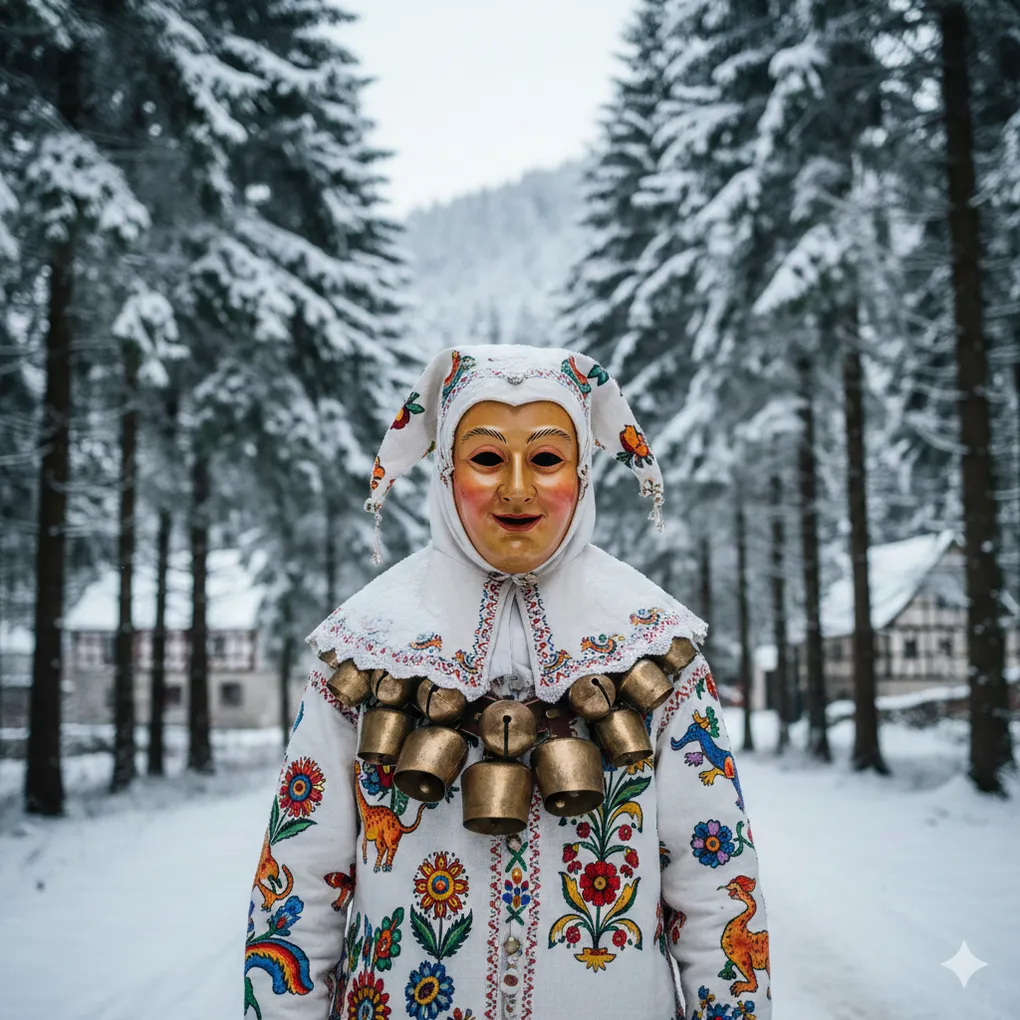
- The Costume (Häs): Made of white linen, meticulously hand-painted with colorful, intricate figures, flowers, and animals.
- The Bells (Rollen): Heavy brass bells worn over the shoulders create a distinct, rhythmic jingling as the Narro marches. These can weigh 15-20 kilograms (33-44 lbs)!
- The Mask (Larve): Carved from lime wood, the mask has a smooth, friendly, and slightly noble expression.
2. The Atmosphere: A Living Historical Pageant
The Villingen Dienstagumzug feels more like a historical procession than a wild street party.
- The “Narro-Marsch”: The entire parade moves to a specific, traditional brass band tune. The fools perform a unique hopping step, causing their heavy bells to ring in unison—a mesmerizing sound that echoes through the medieval old town.
- Strict Adherence: Only those in authentic, guild-approved costumes participate in the official parade. You won’t find modern costumes here; it’s a vibrant display of 16th and 17th-century heritage.
3. “Strählen”: The Playful Gossip
One of the most unique interactions is Strählen (or Schenken).
- Fools carry a “Narrenglas” (a magnifying glass) or a book.
- They might pull spectators aside and, from behind their masks (which disguise their voice), recite poems or “read” out funny mishaps or embarrassing moments from the past year. It’s all in good fun, a playful way to hold a mirror up to the community, protected by “Narrenfreiheit” (the freedom of the fool).
4. Other Villingen Figures
Beyond the Narro, keep an eye out for:
- The Morbili: Elegant female counterparts to the Narro, in historical dresses and delicate masks.
- The Butzesel: A playful “donkey” figure, often causing lighthearted mischief.
- Wuescht: Characters dressed in straw-stuffed sacks, known for their playful interactions with the crowd.
🇩🇪 Essential German Carnival Phrases & Calls
To truly immerse yourself, you need to know the local lingo!
Villingen & Black Forest Specifics:
-
Narri – Narro!
- Meaning: The universal greeting for the Swabian-Alemannic Fastnacht. You shout “Narri!” and the masked fool replies “Narro!”
- Blog Tip: Shouting “Helau” (Düsseldorf’s call) in Villingen is a quick way to out yourself as a tourist!
-
Giizig, giizig, giizig isch de Narro, und wenn er nit so giizig wär, no gäb er au en Malzer her!
- Meaning: “Stingy, stingy, stingy is the Fool, and if he weren’t so stingy, he’d give us a candy!”
- Context: Children (and adults who want candy) use this playful rhyme to encourage the fools to toss out “Malzer” (traditional Villingen candies) or other treats.
-
Rhabarber – Ahoi!
- Meaning: “Rhubarb – Ahoy!”
- Context: This is the unique call of the Glonki-Gilde, a specific group in Villingen who wear white nightgowns and carry lanterns, often seen on “Schmutziger Donnerstag.”
Cologne & Rhineland Specifics:
-
Kölle Alaaf!
- Meaning: “Cologne Above All!”
- Context: The iconic and ever-present greeting in Cologne. Say it often, and loudly!
-
Helau!
- Meaning: The traditional greeting for Düsseldorf and Mainz.
- Context: Never, ever shout “Helau” in Cologne. You’ll be met with confused (or playfully annoyed) stares!
🍽️ Indulge Your Senses: Carnival Foods
No German celebration is complete without delicious food! During the “Fifth Season,” treats are often deep-fried to use up fat before Lent.
- Berliner / Krapfen: These are delicious jelly-filled donuts, a staple across Germany during Carnival. In the Black Forest, look for Fastnachtsküchle—thin, fried dough squares often dusted with powdered sugar.
- Mutzenmandeln: Small, almond-shaped fried pastries, crispy and sweet, perfect for snacking while watching the parades.
- Halve Hahn: A Cologne specialty that’s not what it sounds like! It’s actually a rye roll with a thick slice of Gouda cheese, mustard, and pickles.
- Glühwein: Warm mulled wine is essential to keep you warm during the chilly February parades.
🎭 Carnival in Germany: Know Before You Go
Planning to join the “Fifth Season”? Here is everything you need to know to survive and thrive in the chaos!
📅 The Important Dates
- Schmutziger Donnerstag (Dirty Thursday): The “Women’s Carnival.” Women symbolically take over city halls and cut off men’s ties.
- Rosenmontag (Rose Monday): The peak of the Rhineland (Cologne/Düsseldorf) celebrations with massive televised parades.
- Fasnetdienstag (Shrove Tuesday): The grand finale in the Black Forest, featuring the majestic Dienstagumzug in Villingen.
- Aschermittwoch (Ash Wednesday): The party ends. Costumes are packed away, and the “Nubbel” (straw man) is burned to atone for the week’s sins.
🧤 Survival Tips for Travelers
- Dress in Layers: February in the Black Forest and Cologne is freezing. Wear your costume over your thermal gear or a warm jacket.
- Book Early: Hotels in Cologne and Villingen fill up months in advance. If you’re staying in the Black Forest, look for cozy guest houses (Gasthäuser) in nearby villages.
- Cash is King: While Germany is modernizing, carnival stands selling Glühwein (mulled wine) and Berliner (donuts) almost exclusively take cash.
- The “Tie” Rule: If you are a man wearing a tie on Thursday, expect it to be snipped off with scissors. Wear a cheap one!
🗣️ The Greeting Cheat-Sheet
| Location | What to Shout | When to Say It |
|---|---|---|
| Cologne | Kölle Alaaf! | Everywhere, all the time. |
| Düsseldorf | Helau! | Don’t say this in Cologne! |
| Villingen | Narri – Narro! | When you see a masked fool. |
| Black Forest | Giizig, giizig… | If you want the “fools” to give you candy. |
Pro Tip: In the Black Forest, the wooden masks (Larve) are sacred. Never touch a fool’s mask or try to pull it off. It is considered a major sign of disrespect to the tradition and the artist who carved it.